Product details description
When selecting structural members for frameworks, supports, or fencing,
galvanized square steel (hollow structural section - HSS) and round tubing
(pipe) are common choices. Their structural performance differs due to their
cross-sectional geometry, influencing strength, stability, ease of connection,
and aesthetic application.
The fundamental difference lies in moment of inertia and section modulus,
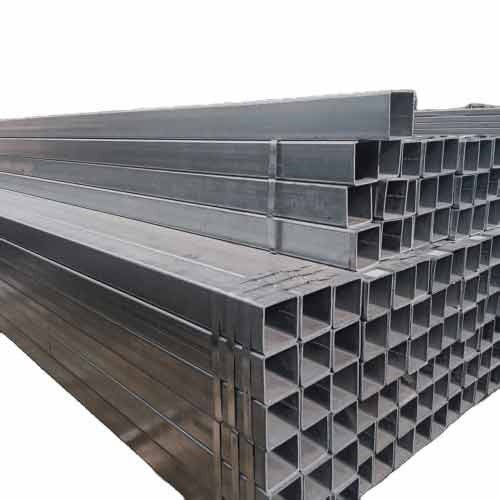
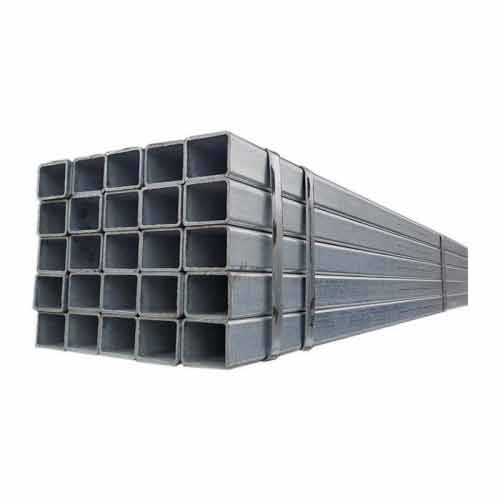
which govern a member's resistance to bending and buckling. Square tubing has a
more uniform distribution of material about its central axes. This gives it a
slightly higher bending strength (in certain orientations) and much higher
torsional (twisting) rigidity compared to round tubing of similar weight and
cross-sectional area. The flat faces of square tubing also make it easier to
weld, bolt, or connect to flat plates and other members, leading to simpler,
stronger joint designs. This makes square tubing a preferred choice for welded
frames, machine bases, and structural supports where members meet at right
angles.
Round tubing, on the other hand, has no weak axis; its geometric properties
are identical in all directions. This makes it exceptionally good at resisting
uniform compressive loading and buckling from any direction, which is why it is
widely used for columns and posts. Its shape is also more efficient at resisting
internal and external pressure, making it the inherent choice for fluid
conveyance (pipes). Aesthetically, round tubing offers a softer, more organic
look. However, connecting round tubing to flat surfaces often requires
specialized bracketry or notching, which can complicate fabrication.
For lateral load resistance (like wind on a fence), a square tube's flat
face presents a larger wind profile, potentially catching more force. A round
tube's aerodynamic shape can slightly reduce wind load. In terms of local
strength, the corners of square tubing can act as stiffeners but are also points
of potential stress concentration if not properly fabricated. Round tubing lacks
corners, distributing stress more smoothly.
Galvanization protects both from corrosion, but the coating may be slightly
more uniform on round tubing due to the lack of sharp corners, though modern
hot-dip processes effectively coat both. The choice often comes down to
application: Use square tubing for frameworks requiring easy, rigid 90-degree
connections, high torsional stability, and a modern industrial aesthetic. Use
round tubing for posts, columns, handrails, and applications requiring uniform
strength in all directions or a smoother aesthetic. In many cases, the
connection method is the deciding factor.
Previous article:
Strength and Corrosion Resistance of Galvanized Square Steel
Next article:
Galvanized Square Steel Production Process: Complete Manufacturing Guide